
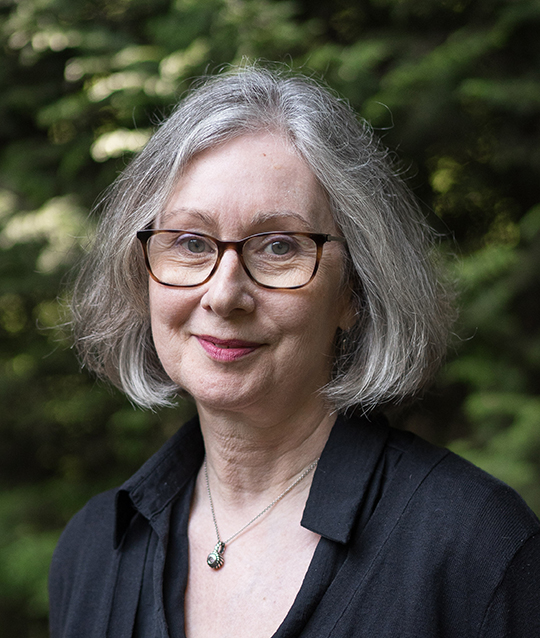
Photo Credit: Photograph by Oliver Mann, 2023. From: https://artscoop.ubc.ca/profile/jane-devine-mejia/
Bio: Jane Devine Mejia is the iSchool Co-op Education Manager at the University of British Columbia in Vancouver, Canada. She was previously Chief Librarian at the Vancouver Art Gallery. Jane spent a decade in the UK, where she served as Faculty Librarian, Modern & Medieval Languages & Linguistics Library, University of Cambridge and was a collections development manager at Screen Archive South East, University of Brighton. From 1997-2004, Jane was the Architecture/Art Librarian at the University of Notre Dame (USA) and she has worked in Montreal as Information Services & Systems Librarian for the National Film Board of Canada. Her career began as a library assistant at the Vancouver Public Library, where she later worked as a librarian in the Fine Arts & Music Division. Jane was active in ARLIS/NA for many years, as a member and chapter chair of ARLIS/Northwest and ARLIS/Midstates, as well as a member of ARLIS/Montreal-Ottawa-Quebec. In 1996-97, she was the Canadian Representative on the ARLIS/NA board and spearheaded the creation of ARLIS/Canada along with Murray Waddington, Head of the National Gallery of Canada Library and Archives. Jane holds a BA (Hon.) in History and an MLS from McGill University, Montreal.
Interviewer: Emma Metcalfe Hurst, Canadian ArLiSNAP Co-Liaison
INTERVIEW
- Can you tell us about your background and how you got into the field of art archives/librarianship? Where did you go to graduate school and what did you specialize in?
- I’m from Vancouver and I spent 2 years at UBC as an undergraduate where I took various electives in French, English Literature, History, and Art History. Then, I spent a summer on exchange to Quebec City on a student work exchange program and I fell in love with Quebec. While there, I went to Montréal, visited McGill, and decided to transfer. When I arrived, I was starting third year and had to choose a major. I decided to choose history as it allowed me to do work related to art and to use my French, so it was the broadest possible option. After graduating, I took a gap year and worked in a children’s bookstore in Montréal, did some freelance visual research, and then got a job at Vancouver Public Library (VPL) where I spent 9-10 months as a Library Assistant I, doing shelving, fixing printers, things like that. At that time, they had a fine arts and music division, and I was primarily working there, so I had that exposure to the workplace. I was trying to decide between an MA in art history and a library degree but applied to McGill and got into library school. At first, I thought I was going to be a public librarian, but then I distinctly remember Loren Lerner coming over from Concordia University to talk to us about her work as an art librarian and establishing the ARLIS/NA MOQ Chapter and I realized that’s what I wanted to do — it all came together. When I graduated, it was a recession, and there weren’t a lot of jobs, so I worked part-time for a public library and I got a job with the Canadian Architecture Collection at McGill, working on a special project to catalog part of the collection, cataloging an architect’s fonds, and then I went to the National Film Board of Canada (NFB). I wasn’t always able to work in art; I worked in film, rare books and special collections, and other related things, but I always knew that I wanted to work in arts and culture.
- What did you specialize in?
- When I was at McGill, we couldn’t really specialize, we could only take electives. I tried to take every opportunity to further my own areas of interest through some of the coursework I was doing, because there wasn’t a course in art librarianship.
- Where do you currently work?
- I currently work with the UBC Faculty of Arts Co-op Office as the iSchool Co-op Education Manager. My job involves developing paid co-op work opportunities for students in the Master of Archival Studies, Master of Library and Information Studies or dual degree programs at UBC.
- How did you find your current position?
- I am replacing someone who has been seconded. I was a co-op employer before I started this position and I also served on the UBC iSchool Co-op advisory committee.
- What position were you previously in?
- I was Chief Librarian at the Vancouver Art Gallery for six years, in charge of managing their art reference library and archives, providing reference services to gallery staff and the public and handling collection development.
- What was your first arts librarianship position?
- My first position was as a student assistant in the McGill Library Rare Books and Special Collections Department during library school. My first job after graduate school was with the Canadian Architecture Collection at McGill, which was part of the Blackader-Lauterman Library of Architecture and Art. I was working as the publications coordinator in the early days of desktop computing. We were creating a database of the architectural drawings using a precursor to FileMaker called Dbase III. There was a team of architectural historians, librarians and students, led by Irena Žantovská Murray, Head of the Blackader-Lauterman Library. I had to work with the architects to decide how to organize the drawings, make them accessible, and figure out which drawings belonged to which project. That was really exciting because I was already interested in architecture, and I learned so much. It gave me confidence that I could enter a project about which I had no prior knowledge, and I could bring my skills, I could learn, build a database and edit publications.
- How did you hear about the position?
- Word of mouth! It’s about the professional network. As I said, I was working part-time at a public library and trying to find something aligned with my interests. One of the archivists at McGill tipped me off about a SHHRC project and they were asking around for new graduates. It was after hearing that — being in the right place at the right time – that I went to the Art and Architecture Library and said I’m interested in the project and asked how to get involved. I was also willing to be paid a less then professional wage so that I could get the experience. I was there for about 10 months, and I can say that the project launched the careers of several other people in arts and culture libraries across the country too.
- What work experience (volunteer and/or paid) did you find to be the most helpful for your career?
- Obviously, the SSHRC project launched my career as an art and architecture librarian but being involved in ARLIS/NA and serving on interest groups, committees, meeting people was critical. I consider that the single-most important volunteer experience, at the chapter level and as the Canadian rep on the board in 1996-97.
- Each job that I did helped me to acquire specific skills. I spent 8 years at the NFB in Montréal, working with a database unit to promote awareness and distribution of Canadian film. It wasn’t a library job, and I was feeling a bit pigeonholed, so I returned to VPL where I worked as a fine arts and music librarian. The time that I spent there allowed me to become an academic librarian in the US, because I had that solid three years doing reference in a specialized division of a public library and they regarded that very favorably because they had a big emphasis on undergraduate programs. It was a matter of identifying my skill gaps and trying to fill them. So, working in public librarianship was very adaptable to working at the University of Notre Dame. I could also see what type of commitment was involved in arts librarianship and you couldn’t be half-hearted about it.
- What do you wish you knew about arts librarianship / archives as a student studying in a Canadian context?
- At the time I studied, it was pre-internet. There was not a lot of information about what was going on across the country, everything was very regional. The vastness of our country continues to be a challenge today and now we have even fewer institutions, and opportunities in arts librarianship. That wouldn’t have deterred me in any case, but having French as a second language made my career possible. I could not have worked at NFB or been involved with ARLIS/NA MOQ without it. For anyone who wants to work at a federal institution or an institution that is inclusive of the full Canadian context, you have to have at least some French. It was also clear that it was a “design your own degree” situation as there wasn’t an obvious path into the profession and no art librarianship classes were offered at McGill. I don’t know if that’s changed very much. Melva Dwyer might have taught a class in art librarianship many years ago at UBC and Loren Lerner may have taught one at McGill, but there was nothing consistent in Canada. There were very few educationa
lopportunities to learn about art librarianship. The specialization at Indiana University established by BJ Irvine is a popular program for art librarianship in the States.
- At the time I studied, it was pre-internet. There was not a lot of information about what was going on across the country, everything was very regional. The vastness of our country continues to be a challenge today and now we have even fewer institutions, and opportunities in arts librarianship. That wouldn’t have deterred me in any case, but having French as a second language made my career possible. I could not have worked at NFB or been involved with ARLIS/NA MOQ without it. For anyone who wants to work at a federal institution or an institution that is inclusive of the full Canadian context, you have to have at least some French. It was also clear that it was a “design your own degree” situation as there wasn’t an obvious path into the profession and no art librarianship classes were offered at McGill. I don’t know if that’s changed very much. Melva Dwyer might have taught a class in art librarianship many years ago at UBC and Loren Lerner may have taught one at McGill, but there was nothing consistent in Canada. There were very few educationa
- Are there specific courses / workshops / professional development opportunities that you found helpful for getting a more well-rounded and specialized skill set for the work you do now or have done?
- I mentioned languages and, out of interest, I did a certificate in Italian. If you’re going to be an art librarian, you need more than one language, whether that’s French, Italian, Spanish, German or Japanese.
- ARLIS/NA offered the best professional development opportunities, whether that’s getting involved in the local and regional chapters or attending the national conference.
- I wish I had taken a class in preservation. I had to pick up a lot on the job working with conservators and curators.
- I also wish I’d taken a “History of the Book” class, which is beneficial for working with rare art books and having a better understanding of the book as artifact. There is the Rare Book School. It is valuable to understand the genesis of the book, current trends in art publishing, digitizing projects, cataloging, as well as contemporary publishing.
- An understanding of basic terminology and identification of art types and studio arts. This helps you understand what materials and which media students are working in. Whether that’s taking an art class, or joining a club, having that physical knowledge really helps to have a material understanding. It also improves your credibility with BFA and MFA students, as it helps you understand some of the challenges they’re facing.
- When you’re working with art students, you need to go to their shows and be connected to really understand physically what they’re doing. Going to their shows and supporting them is part of your professional development.
- Do you have any advice for current students and/or those in or entering the GLAM job market from the Canadian context?
- It’s challenging. Over the past 30 years of my career, staffing levels have declined –especially in museum libraries, which are becoming an endangered species in Canada. You have to be very intentional and committed. You have to be willing to take on contracts, work on grant-funded projects, and be strategic about following job lists, monitoring things closely, and using your professional network to hear about things. Try to find openings such as a residency, internship, and fellowships to get your foot in the door.
- I worked in Canada for the first 11-12 years of my career and then went to the US for 7 years. There were no art library jobs in Canada at that point, so it was either leave the country or work in public librarianship and wait. You must be willing to move around and across the country to various institutions.
- Do you have any additional tips or resources that you’d like to share about any the following:
- Job boards – The ARLIS/NA job postings would be the main website, but it’s also useful to keep an eye on the Chronicle of Higher Education in the States, SLA, LinkedIn, and government job boards. Think: “What’s the type of thing I want to do? What kind of institution is it? And where do those institutions advertise their positions?” For instance, the National Gallery is in the government sector, so the places they post won’t necessarily be art-related. If you’re looking regionally, you may have to make a list of all the institutions on a regional or local level, then mine the local job listings as there is no master index. LinkedIn is useful for reaching out to people and notifications, but in terms of comprehensive listings, it’s not very extensive.
- Mentorship opportunities – ARLIS/NA is an obvious path to mentorship opportunities, but depending on where you are, seek mentors in your workplace. There is always formal mentorship, but also people where you work whom you could learn from, or who could be role models, and that can serve as mentors throughout your career.
- Scholarships – Rare Book School and Summer Education Institute (SEI) Workshop. Some of the library schools offer niche scholarships for students with specific interests. Go through the lists of scholarships at your institution. Often, you can find conference attendance awards, including ARLIS/NA or the Association of Architecture School Librarians (AASL).
- What do you enjoy most and what do you enjoy least about being an art archivist / librarian?
- The chance to meet extraordinary people doing amazing things, being part of research, and being part of students’ careers — seeing them graduate and then go on to be artists, designers, and architects. That sense of being involved in the creative sector is exciting. Of course, the more frustrating aspects are budgets, staffing levels, and sometimes being a solo librarian in GLAM, but you don’t do it if you don’t love what the purpose of it is, which is to document art and be part of the creative world.
- If you could go back in time and do part of your career or education over again, is there something you would have changed? A class you would have taken? A missed opportunity? Things you wish you had known or done differently to broaden your job possibilities?
- I would think beyond North America and be more adventurous. I would pursue art-related trips outside of my comfort zone and look for opportunities further afield, such as looking at the national library associations, other national ARLIS associations, and scholarship databases to find travel stipends and international events to attend.
Blog Series Description: Interviews with Canadian Art Librarians & Archivists is a blog series that highlights the professional trajectories of established and mid-career Canadian librarians and archivists working at the intersections of arts, culture, and information in Canada, the US, and internationally. This series supports students and early-career information professionals entering into arts librarianship from a Canadian context by providing valuable insights into pursuing this work and sharing a variety of career trajectories. Over the coming months, interviews will be released on the ArLiSNAP website and Instagram. This project was initiated by Ashley Huot and Emma Metcalfe Hurst, the Canadian Co-Liaisons for ArLiSNAP since 2022.